

As the saying goes, the mighty baobab starts life as a tiny seed. We planted the seed for African Banker two decades ago, more in hope than expectation, since there was nothing else quite like it in the international publishing world. The continent’s banking industry was very much on the periphery in global terms and was often described as being on ‘life support’.
It may come as a surprise to our younger readers that indeed, this description was not far from the truth. The process of decolonisation meant that a host of vital processes and systems which had been wedded to those of the colonial overlords were being severed. This took different forms in different jurisdictions – in some the process was relatively smooth and orderly, in others it was abrupt and discombobulating.
Keep in mind that the entire colonial system – whether British, French, Portuguese or Spanish – was built on the extraction of produce from Africa to the metropoles in Europe, as well as the transfer of basic manufactures.
The primary task of colonial officers – and settlers – was to maintain this system and adapt various approaches to suit various geographies and local cultures. The banking system was therefore constructed around the offshoots of metropolitan banks, which facilitated trade and finance that supported the system.
While a few local businesspeople were able to open accounts, the main customers were foreign firms and their staff who could also use services such as deposits, cheques and over-the-counter withdrawals.
After independence in 1947, a small number of Indian banks, (later joined by the Pakistani Habib Bank) opened branches in East and West Africa to cater to the needs of sub-continental traders who had settled there.
Following independence in most of Africa during the 1960s, the international banks opened their doors to select customers – either well-established businesses or professionals and carried out both domestic as well as international banking. However, the majority of the populations were shut out of the official system, leading to the well-known ‘unbanked’ phenomenon that countries are still struggling to address.
While independence and therefore the collapse of the old colonial political system brought chaos in many parts of Africa as ambitious individuals and parties rushed to fill the void, it also generated an explosion of trade – mostly in the informal sector but also considerably in the formal sector.
With formal banking avenues closed, cash became king (and it still maintains its suzerainty in many African countries – although mobile money is replacing it rapidly). It was a common sight in African streets to see businesspeople with briefcases bulging with currency notes, often handcuffed to their wrists, and armed guards in tow to deter thieves.
There was a yawning demand for banks that would cater to the needs of indigenes and provide them with safe deposit and withdrawal facilities, including cheques as well as loans. Nature as well as economics abhors a vacuum and all sorts of individuals as well as organisations – some hastily set up – rushed to fill the vacuum.
This period is well-documented but it is often referred to as the ‘Wild West of African banking’, with new banks popping up seemingly by the day and collapsing just as quickly. Out of the rubble, a few emerged strong and stable but the industry itself was looked on with suspicion, with most people maintaining their faith in their own safes and in cash.
Enter African Banker
It was in this febrile atmosphere that we made the decision to launch African Banker. Initial reactions were very negative. “How can you have a magazine for an industry that does not exist?” was among the comments we received from often well-meaning people. “African banking is in total chaos – what will a periodical dedicated to it achieve?” was another comment that has stuck in my mind and of course, many warned us not to throw good money after bad.
They had a point. But our entire history of publishing as a group had been based on what we perceived as the larger picture, rather than the immediate reality. African Business had become a success when we switched focus from multinational and Western entities to focus on often little-known African entrepreneurs.
We provided the platform and they and their organisations thrived and what was more important, business information was no longer confined to national silos as in the past, but accessible across the continent. The exchange of ideas was invaluable and the success of entrepreneurs in one region or country was immensely inspiring to others elsewhere. African Business was going places. But while business in general was settling down and had developed the knack of riding political upheavals, the banking industry, vital to the health of African enterprise, was struggling.
This sector, which was composed of a few large international Western banks and a multitude of smaller, undercapitalised and poorly managed local banks, had failed to keep pace with the progress made by other commercial entities.
Banks were locked in tight national silos with little or no information on what else was happening on the continent. Only Ecobank, with its clear pan-African mandate, was looking at the bigger picture.
Bank failures were frequent and regulatory authorities were weak, often undercapitalised and understaffed. For the majority, even in urban centres, trust in the system was almost non-existent. Most commercial life was carried out on a cash basis. The cream of Africa’s talent was often trained and employed by Western multinational banks such as Citi Bank, J.P. Morgan and so on.
While local banks around Africa were trying to find a place for themselves to serve the interests of the new local commercial classes and national governments, the situation in Nigeria had become dire. Trust in the system was virtually gone as scandal followed scandal and bank failures multiplied.
The big bang
Something had to be done. In 2004, the Governor of the Central Bank, Charles Soludo, unleashed the ‘Consolidation big bang’. He raised the capital threshold more than 10-fold from N2bn to N25bn ($190m at the time).
This sent many of the banks into panic mode. They could only raise this amount of money through mergers, acquisitions or by raising fresh capital. Other requirements in Soludo’s 13-point reform agenda included the adoption of a rule-based regulatory framework that was more risk-focused, ensuring greater compliance and transparency and vastly improved corporate governance.
No other reforms in Nigeria’s financial history had gone so far or bitten so deep. A scramble for M&A and fundraising ensued, as did headhunting for skilled and qualified executives.
This brought in a fresh batch of gifted CEOs and managers, many of whom had held important positions in international banks. They saw vast opportunities in the new landscape – in which only 25 banks remained standing after the dust had settled – and were hungry for success. A bright new chapter had opened in the Nigerian banking story and the rest of Africa wanted to hear all about it.
Our entry into publishing for the sector was serendipitous. Recalling the birth of African Banker, I have written elsewhere: ‘Momentous developments often have a fairly prosaic beginning. In 2007, following a series of explosive events in the banking sector in Nigeria and on advice from some of our most astute advisors, including Nigeria’s Central Bank Governor at the time, Charles Soludo, we launched African Banker magazine as a quarterly.’
There was hardly any information about the industry from one region to the other. Occasionally, a Western publication might publish an often negative story about bank collapses in this or that country, but give very little on the institutions that were successful.
Unlike in the West, there was no platform for bankers to examine the state of the industry or discuss its requirements. African Banker, we hoped, would provide this platform and in time become the glue that held the continental industry together.
We decided from the outset that African Banker, in terms of the quality and depth of writing and design, would be the best available on the market, including top Western publications. But how would the continent’s bankers, scattered far and wide, respond to the publication?
It took a while for the idea to catch on that here was an international publication, produced in London, that took the industry very seriously but once it had, the response was overwhelming.
Like we had done for African Business, the stars of the show, taking centre-stage, were now African bankers, and the coverage focused on their activities as the central issue rather than as a sideline
to others. Our focus on outstanding bankers has continued to this day with issues of African Banker containing exclusive interviews and profiles of the top players.
Over the years, profile after profile, interview after interview showed the maturity, the originality, the sophistication and the ambition of African finance leaders. Views were echoed, discussed, amplified and modified across Africa. African banking had found a common voice and it spoke loudly and clearly – and the world listened.
Something significant
To return to the genesis of African Banker. Back in 2007, we were still deeply engrossed in the African Business project, which also involved ‘retraining’ our correspondents to think differently, and working with some of the companies interested in advertising to adjust from a local retail focus to selling their brands internationally, when the call came to launch a publication specifically for the banking and finance sector.
I had the privilege to be the first editor of African Banker, but it was new territory for us. We set out to look for the best finance writers we could find but the going was tough – most were reporters working on national dailies and had no clue what sort of stories would interest a pan-African or rather, an international audience. However, where there is a demand, the supply will come and we gradually built up an excellent team of correspondents and commentators.
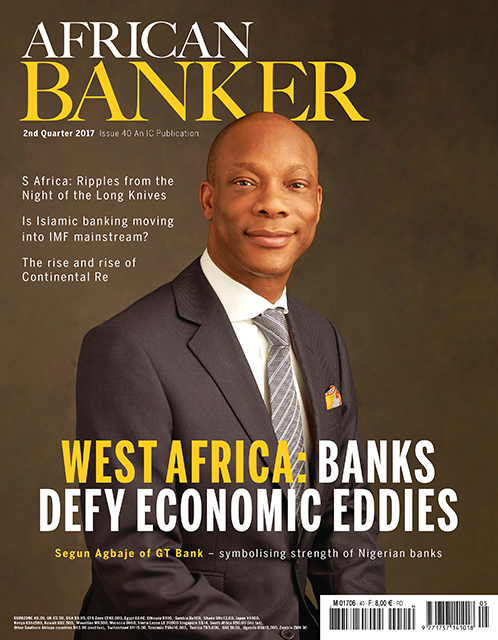
In addition to making the bankers and regulators the stars of African Banker, through features and interviews, we ran robust analysis and didn’t pull our punches when we felt criticism was due. As it has done in all our publications, the pan-African theme ran like a river through the magazine.
African Banker was an instant hit, with demand for copies increasing daily. Many of our stories and interviews were lifted and reproduced in newspapers and finance magazines all over the continent.
With the new platform now established, important people in the banking and finance world reached out to us and made strong connections. We were a natural fit for people like Arnold Ekpe, the now legendary former CEO of Ecobank, or Jean-Louis Ekra, the former president of Afreximbank, or Aigboje Aig-Imoukhuede, the former CEO of Access Bank, among many others. These early connections have remained firmly in place to this day.
Donald Kaberuka, the former president of the African Development Bank and a man very well aware of the power of the media to get things done, invited us to the organisation’s HQ in Tunis at the time, and gave us carte blanche to interview whoever we liked. This was in sharp contrast to the earlier policy of secrecy that had surrounded the bank and the publication of the feature changed the image of the bank almost overnight. This was the ‘start of a beautiful friendship’ that endures to this day.
Time ripe for awards
African Banker had come into existence, with the first edition dedicated to the launch of the Africa Finance Corporation (another of Professor Soludo’s brainchildren), thanks largely to Christian Udechukwu, who was a regular and very welcome presence at our offices. He also suggested the time was ripe to set up the African Banker Awards.
After the shocks of the early 2000s, African banks were in a much more comfortable place and many were expanding – both domestically as well as multinationally – at a rapid pace. This allowed many to survive the financial crisis of 2008 and proved that they could be resilient to global shocks and contribute to their nations’ development.
The parameters and indices were also changing with issues like governance, CSR, inclusivity, efficiency, transparency and adaption to new technology and methods coming more to the fore.
“It’s time to find out the best of the best in each category and benchmark it,” we said. “And the results need to be watertight so that no one can question the credibility of the awards.” This was the unanimous sentiment of Afif Ben Yedder, who was the publisher then, Omar Ben Yedder, then the associate publisher, and myself.
Christian Udechukwu, as co-founder of the Awards, was a great ally in this venture, as he was a vital link between the Nigerian government, the Central Bank, the commercial banks and interested parties in the UK. Through his BusinessinAfrica Events organisation, he brought diverse people together and set into motion very many valuable connections.
Initially we decided to shadow the annual World Bank General Meetings in Washington, by setting up the awards ceremony to run in tandem with the occasion. Most of the top African bankers, central bank governors, Ministers of Finance and so on would be attending the meetings. It was also the time to showcase excellence on the global stage. Later we switched to shadowing the AFDB’s annual meetings for the prizegiving, wherever these took place.
Our event would round off the week and would provide not only welcome relief from the round of dry talks and discussions, but bring together the continent’s banking community to break bread, get to know each other and enjoy an evening.
Omar was already breathing life into an IC Events department that had lain dormant for years. The ‘ABK Awards’ as we shortened them, would be his baby.
Looking at the prospect of running the awards abroad, he said: “Africa deserves the best – we don’t compromise. Every event will have to be a showpiece.”
The first awards ceremony was to be held at the Grand Hyatt hotel in Washington DC in October 2007. Omar was under no illusion. He knew the task would stretch his organisation and leadership capacity and that of his teams to the breaking point as it would involve staging the event far from home, in Washington and logistics were daunting.
The event was an unqualified success but at that point no one knew that staging the annual awards would become such an adventure and throw up so many challenges.
We decided that we would give awards for several categories of activities, with the big gongs going to the Bank of the Year and the Banker of the Year, although the Central Banker of the Year and the Finance Minister of the Year awards were also high in prestige value. We would also give outstanding bankers a Lifetime Award.
Once the call for entries had gone out, the team had to sift through every document that arrived and make a longlist, before a smaller team would cut it down to a shortlist. Then judges had to be appointed and briefed and given the shortlist for their final selection. The announcement of the winners would be made during a gala night which would also include some entertainment.
Easier said than done, of course. Even when everything had gone to plan and the team was safely at the venue, at times it seemed as if everything that could go wrong did – essential items went missing, venues had to be changed at the last minute, invitations got snagged up, the sound and other systems were not ready with minutes to go; the awards were languishing in some customs shed; some of the guests were messing up the sitting arrangements and so on; but in the end, by the grace of providence and an astonishing degree of composure under fire on the part of Omar and his team, everything turned out right.
Mending and making do
While the first awards ceremony took place at the Grand Hyatt in Washington, the second was upgraded to the Willard Intercontinental, a hotel steeped in history. With the World Bank meetings taking place outside of Washington every third year, in 2009 the awards left the city to move to the Four Seasons Hotel at the Bosporus, Istanbul, Turkey. It was a very enjoyable affair with the Turkish hosts providing great hospitality. The awards were now truly global.
The next two events were held back at the Willard InterContinental Hotel, Washington DC but then there was strong lobbying that instead of shadowing the World Bank, our awards should be held during the African Development Bank’s annual meetings. We readily agreed as it made a great deal of sense.
We were in Arusha, Tanzania for the first of these awards in Africa, in 2012. I remember that due to some misunderstanding, the venue we had booked was no longer available. To make it worse, there was no other venue that could cater for around 400 people.
We were at our wits’ end when someone suggested setting up big marquees on a field. But with the recent rains, the ground would be soft and muddy, we felt. No fear, a small group of Indians contractors turned up and said they would cover the ground with wooden platforms and set up the tents. “Can you do it in time?” Omar asked. “It is not a problem,” the leader answered. He gave the same answer to every question we put to him – which was a problem.
But sure enough, on a clear moonlit night, with Mount Kilimanjaro’s bulk in the distance, the venue was up and ready, festooned with torches and lights.
For the catering we persuaded the lady who ran a small boutique hotel we were staying at to go for the big time and provide meals for 400 instead of a dozen. She took it on, trained a few young people to wait perfectly, and the meal and the awards ceremony were a huge success.
Three years later in Abidjan, Côte d’Ivoire, the ice-rink at the Sofitel Hotel had to be converted to a gala dinner and awards venue in double-quick time. The Senegalese pop idol Baaba Maal headlined the evening’s entertainment. In Zambia in 2016 we had to build a tent in the gardens of Lusaka’s Intercontinental Hotel – but again, things went swimmingly.
The 2014 event in Kigali was later defined as the ‘heavyweights’ night’. Among the VIP guests were Presidents Paul Kagame of Rwanda and Faustus Mogae of Botswana, Donald Kaberuka, Mo Ibrahim, Ngozi Okonjo-Iweala, and Arunma Oteh among others. All said they had enjoyed the event and been impressed and in some way, we would like to think that our event was perhaps among the first that
established Kigali as a major conference centre.
But by general acclaim, the 2013 event held at the Taj Palace, Marrakech, Morocco was the best. This event was staged in collaboration with famous designer Ozwald Boateng and his Made-in-Africa Foundation. The setting in the ancient city of Marrakech, surrounded by desert, added an extra esoteric dimension and the entertainment provided by musical stars such as John Legend, Akon and Youssou N’Dour, added to the wonderful Moroccan cuisine, made it a night never to be forgotten. The awards took us to many places around the world including Busan in Korea and Ahmedabad in India. We often worked with local contractors to give the event colour and grounding and for the bankers and other attendees, the opportunity to meet with and discuss issues of mutual interest was invaluable.
One outcome of the awards is that they helped to break down the silos, or even echo-chambers of most of the national banking sectors, as those who threw their hats in the ring had to take into account what other banks in different jurisdictions were doing. So there was a lot of cross-fertilisation and exchange of ideas and processes.
“What the competition forced us to do,” one banker told me, “was to take a fresh look at our systems and models and ask ourselves if this was the best we could do. So even if we did not win, entering
and presenting our case was a great exercise in improving our performance and trying to match up to the continental benchmark.”
For the winners of course, the awards have been greatly cherished trophies. They say these are not only the best locally but continent-wide. “Winning an award has been a great boost to us morally and has given our staff, and even our customers, a feeling of great pride. In addition of course, we have used the award to its full extent in our advertising and PR – and the results have been great. We shall continue to strive to win other awards in the future,” said another banker, this time a major winner.
It goes without saying that we could not have staged any of the awards without the unstinting support of our sponsors. These are organisations with a wider and longer-term view of African banking and its place in the continent’s economic development. The list is too long to reproduce here but Ecobank, Afreximbank, the African Development Bank, and the Nigerian Bank of Industry have been stalwart supporters over the years.
The Awards have evolved alongside the rise of African banking itself, a transformation mirrored in the journey of our Platinum Sponsor over the past decade, the African Guarantee Fund. Under the leadership of Felix Bikpo and Jules Ngankam, the institution has steadily expanded its influence and continental reach. Established to encourage banks to lend to the SME sector through guarantees and structured risk-sharing, the Fund has, since inception, unlocked some $6.5bn in financing for small and
medium-sized enterprises. In doing so, it has demonstrated not only that SME lending is possible, but that it can be both sustainable and profitable.
The success of the awards is also very much our sponsors’ success.