
Water and sanitation were the main themes of the 2026 African Union Summit in Addis Ababa, with governments, development partners and business talking about how to transform a life-giving sector that has enormous, mostly unrecognised, economic value. It is a major challenge. Across sub-Saharan Africa, about one in three people still lack access to basic drinking water services while about two in three lack access to sanitation services. The situation is particularly dire in rural areas.
For years, water and sanitation have been treated as the poor cousins of government budgets in Africa, with finance flowing more readily to more high-profile areas of the public service. Statistics clearly show the delivery gap.
At a side meeting alongside the main summit, several African presidents affirmed political support for transforming the sector, highlighting its importance for development and economic growth.
At another meeting on the margins of the summit, development partners, ministers, business and other stakeholders discussed the nuts and bolts of necessary reforms and how serious funding can be raised to support accelerated access to water for millions of Africans.
Vital to any economy
Such a transformation is underpinned by the need to shift thinking about water from it being treated as a social sector to agreement that it is an economic sector, one which is critical for development, job creation and investment.
This shift is being championed by the African Union through its development agency, AUDA-NEPAD, which in partnership with the World Bank is focusing on improving access to water, sanitation and hygiene (WASH) across Eastern and Southern Africa. The proposal rests not on fragmented interventions but on a “systems change” strategy to drive sector-wide transformation.
The Multiphase Programmatic Approach (MPA) is Sub-Saharan Africa’s largest multi-country programme on WASH, with a proposed $2.6bn total investment envelope, of which $1.6bn is World Bank financing. The aim is to unlock private capital for bankable projects in a sector generally marginalised by investors. This would complement other sources of funding, including financing from national budgets of participating nations.
By 2032, it aims to deliver sustainable WASH services to more than 30m people in 12 countries. Similar multi-phase programmes in Western and Central Africa are targeting 20m people.
The participating countries are Angola, Burundi, Comoros, Democratic Republic of Congo, Ethiopia, Madagascar, Malawi, Mozambique, Somalia, South Sudan, Tanzania and Zambia.
Others are already in the planning stages to join the initiative.
The WASH Compacts represent presidential-level commitments that anchor financing, reforms, and accountability.
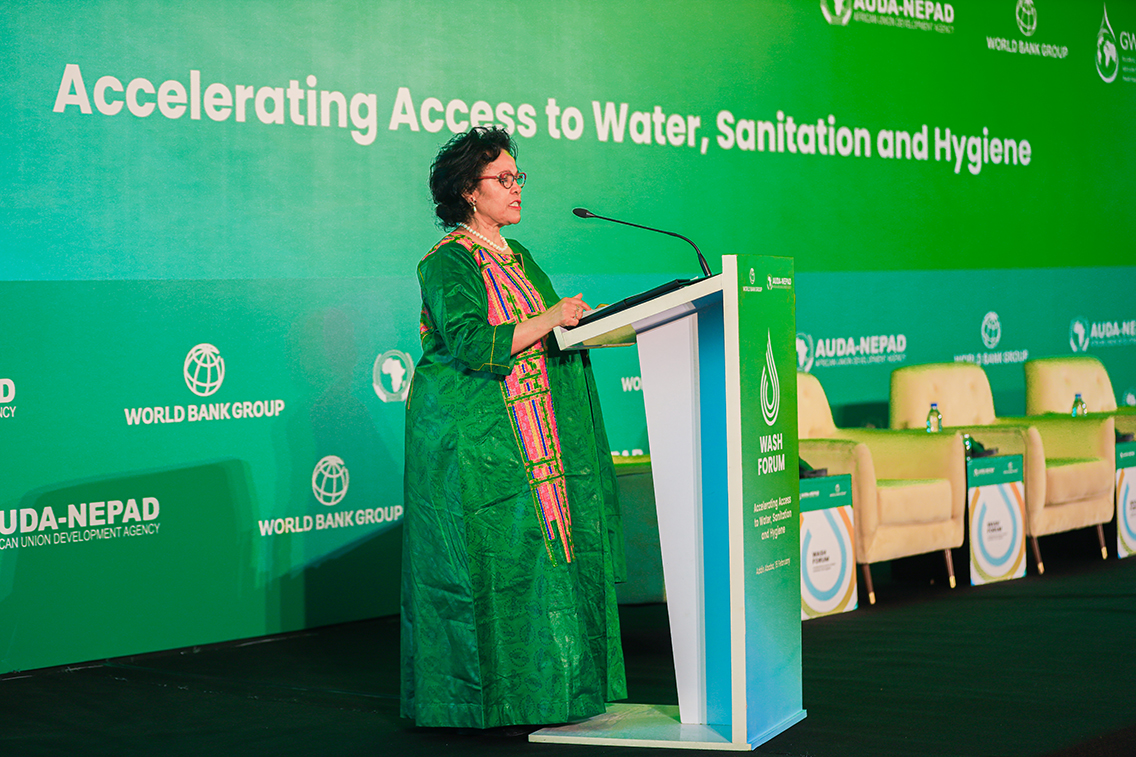
Nardos Bekele-Thomas, CEO of AUDA NEPAD, summed up both the problem and the new direction stakeholders are taking in the water sector. “For too long, water and sanitation in Africa has been framed primarily as a humanitarian crisis: a charitable cause managed through fragmented aid, emergency relief, and endless pilot projects,” she said, speaking at the launch of Accelerating Access to WASH Regional Programme in Addis Ababa.
“Today, we draw a line in the sand. We must shift permanently from a humanitarian posture to a business- and solutions-driven posture. Let me be absolutely clear: access to water is a human right. But the investment, infrastructure, and operations required to guarantee that right—that is a business.”
Ndiame Diop, Vice President, Eastern and Southern Africa at the World Bank, told the launch, “WASH underpins economic growth, and resilience. Globally, an estimated 1.7bn jobs depend on water sensitive sectors – agriculture, manufacturing, energy, and services. When WASH systems fail, health costs rise, productivity falls, and fiscal pressures increase.”
Political will
Large doses of political will are required to maintain the transformation momentum. For the initiative to succeed, governments need to embark on a wide-ranging set of reforms to enable them to attract finance, enable public-private partnerships, increase accountability of strategic actors and monitor delivery.
This includes reform of utilities, policy and investment frameworks and making difficult political choices about how to price water in a way that does not punish the poor but keeps systems solvent.
Junaid Ahmad, Vice-President of Operations of the World Bank’s Multilateral Investment Guarantee Agency (MIGA), said many governments, cognisant of the poverty in their nations, worried about the political blowback of market-related water tariffs.
However, he said, “My experience has shown me that free water is the most expensive water. And that it’s often not a lack of willingness to pay that is the issue but rather a lack of willingness to charge. So how do we change the dialogue on pricing water?”
Serious reform of state-owned water utilities is another potential hot potato. Water-related institutions and utilities, often underfunded and poorly managed, need to become creditworthy to enable them to raise finance from the markets and from development and commercial partners. Roadmaps to show pathways towards creditworthiness are critical to get new funding streams.
AUDA-NEPAD has pledged technical support to help countries update their legal and regulatory frameworks so that water utilities are managed more like efficient businesses than struggling departments.
Various speakers pointed out that it is more effective to fix the institutions that manage leaking pipes than to fix the pipes.
Mtchera Chirwa, Director of the Water and Sanitation Department of the African Development Bank (AfDB), said WASH compacts will align all partners around a clear plan that is country-owned and that identifies necessary reforms.
The AfDB would play a role in supporting these priorities, including those for investment and infrastructure. “Once you have an investment portfolio and government and regulatory reform, it becomes much easier for partners to help governments to structure their investments for private sector uptake.
“Water flows via the path of least resistance. Capital, like water, is looking at the path of least resistance. We need to see where there is resistance and provide the support to overcome this.”
Engaging the private sector
At the launch a number of countries that have signed up to the WASH compact shared the situation in their countries, their targets for improvement and actions in place or under way to reach those targets.
All those who participated in the event highlighted their desire for full water and sanitation access coverage and indicated their willingness to do the necessary reforms and capacity building. They spoke about a commitment to identify infrastructure priorities and work with partners to build bankable project pipelines.
A commitment to engage the private sector – new to many officials and others in this sector – was made clear.
Hassan Kibeya, Minister of Mineral Resources, Energy, Industry, Trade and Tourism for Burundi, said, “We’ve learned through experience that WASH infrastructure cannot be sustainably built without a viable economic model to support it. This realisation has driven us to reform our approach. We’re reviewing tariffs to introduce more progressive structures, designing projects with stronger financial viability in mind, prioritising operational efficiency, and actively optimising costs across the board.”
Semereta Sewasew, Ethiopia’s State Minister of Finance for Economic Cooperation, said: “We are prioritising strong governance, improved performance and efficiency and creating space for various actors to come in like the private sector where we have not had much engagement before.”
José Maria Neves, President of Cabo Verde, added his voice: “My country has faced drought and we have learned that water should not be taken for granted. We have learned that resilience lies in knowledge, innovation and respect for nature.”
Azali Assoumani, President of Comoros, said his country was surrounded by the ocean but fresh water is becoming “dangerously scarce”.
“Africa has made a clear political choice – a choice for survival and for the future: to place water at the absolute centre of our human, economic, and climate security.”