
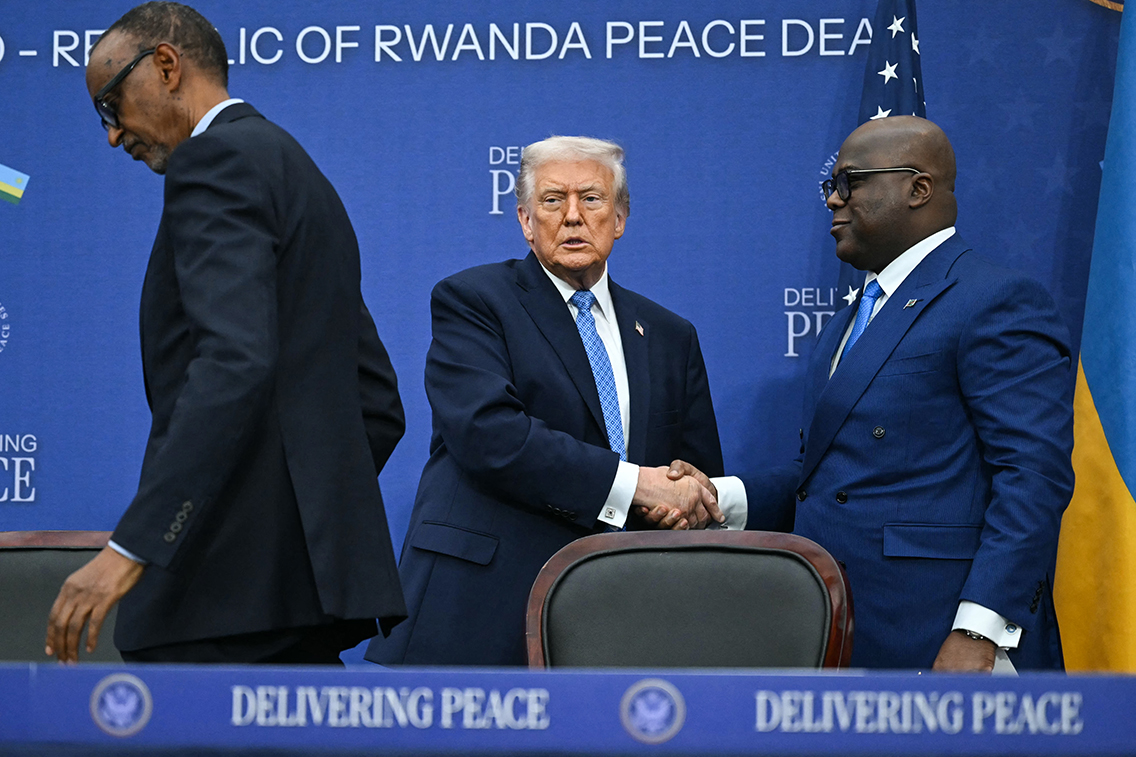
The intermittent effect of peace accords between the Democratic Republic of the Congo (DRC) and Rwanda / M23 continues to create confusion and instability in the eastern part of the DRC. There were high hopes in 2025 that the conflict would be finally resolved when the DRC and various parties involved, including Rwanda and M23, signed two major peace deals, including the much-touted Washington Accords for Peace and Prosperity – signed in June and ratified in December 2025 – and a Declaration of Principles between DRC and M23 signed in July in Doha.
However, fighting broke out even before the ink was dry, with Rwanda accused by both the US and the UN of fuelling the conflict.
Although this long-running conflict is currently restricted to the border areas in the east, around Kivu province, the effects have wider repercussions throughout the country and the surrounding region, especially Rwanda, Uganda, Tanzania and Burundi. Conflict has displaced millions and is costing the DRC dearly in terms of operational costs as well as lost commercial activity. The international focus on the conflict detracts from the attention that should be paid to the DRC’s economic and development aims and achievements.
For DRC, the objective is clear – it wants to secure all its borders and place all its territory under the control of the government in Kinshasa.
Destabilising forces
The destabilisation and conflict in the area have resulted in massive disruption to daily life. According to the United Nations “about 7.8m people are internally displaced, ranking DR Congo alongside Sudan and Syria in terms of total refugee populations” and the Centre for Preventive Action says that “nearly 358,000 people have been displaced in DR Congo since the start of 2024, with 23.4m experiencing food insecurity and 1.1m registered as refugees outside the country.”
Eastern DRC is also a major conduit for trade with the rest of the East African community and a vital transport link for its natural resources to reach the seaports of Mombasa in Kenya and Dar es Salaam in Tanzania. A very substantial part of the DRC’s revenue is from its mineral exports and threats to this flow are unacceptable to the country.
The area is also adjacent to the mineral-rich areas of Katanga and Kivu – sources of vast quantities of copper and the cobalt that is found with it, of niobium and tantalum ore coltan. There are large deposits of gold, uranium and diamonds. The DRC also has considerable deposits of rare earth metals and other critical minerals which are essential to advanced industrial production.
Unrest in these areas is therefore lethal to the country’s economic superstructure, especially with evidence that a steady stream of smuggled minerals passes through the border areas and that many of the militias are motivated by the easy wealth they can expect from smuggling.
Rwanda says its only motive is to check the destabilising influence of the Interahamwe, the deadly Hutu force responsible for most of the Rwanda genocide.
The M23 was established in 2012 by former members of the National Congress for the Defence of the People (CNDP), a Rwandan-backed rebel group largely composed of Rwandan Congolese fighters. They had previously integrated into the Armed Forces of the Democratic Republic of the Congo (FARDC) under the terms of a 2009 peace agreement. However, in May 2012 a group of these ex-CNDP fighters mutinied, forming M23 and citing the government’s failure to uphold the peace accord.
Their intentions are not clear, but from statements it seems their aim is to hive off the mineral-rich areas around Kivu and the border cities. The UN says that there is evidence that the M23 is backed, funded and organised by Rwanda, which wants to establish a cordon sanitaire around their western border, but Rwanda has denied this.
The UN group of Experts have noted that “the objective of the RDF’s military operations on DR Congo territory, known as ‘operations in North Kivu’, was to strengthen the M23 by supplying it with troops and equipment and to use it to take control of mining sites and gain political influence in DR Congo.”
The permanent members of the UN Security Council have also weighed in. At the 10063rd meeting of the council, members, especially the United States, bluntly accused Rwanda of supporting the M23 and demanded that it withdraw unconditionally from Congolese territory.
Invoking the spirit of dialogue
There is no doubt that the conflict is a major drain on the countries involved and is holding back much-needed investment in both DRC and Rwanda.
It also explains the US role in brokering the Washington Accords and getting presidents Félix Tshisekedi and Paul Kagame to ratify the deal in Washington at a ceremony attended by President Donald Trump, Secretary of State Marco Rubio and other high-ranking US, African and Middle East officials.
At the signing ceremony Trump said the US would send “some of our biggest and greatest companies over to the two countries and we’re going to take out the rare earth, take out some of the assets and pay. Everybody is going to make a lot of money”. The statement was criticised by many for its transactional tone, but undeniably, diplomatically at least, the relationship with the US is strengthening as it recognises DRC’s strategic importance, not just in terms of minerals but also as a future economic powerhouse.
The US is also aware that the DRC’s mining industry has in the last two decades been dominated by Chinese companies, which now have a near-monopoly on the extraction, processing and marketing of essential minerals that are essential in the manufacture of high spec electronics.
Lasting peace
For the US and other Western countries to make a comeback into Africa, especially into the DRC, it is essential that a lasting peace is established all over the country and that the borders are secured, especially against non-state actors such as M23, which can cause untold damage to the situation.
So even though the peace accords have not yielded the expected dividends, it is essential to maintain the spirit of dialogue – the theme for the 2026 World Economic Forum in Davos – to ensure that the last mile is crossed and peace reigns once again in this region.